The uprising they said would never happen

March 17, 2011 6 comments

Syrians do not want “chaos”. The Syrian people all love their president. Syria was immune to change because of its anti-Israel stance. Syrians do not want “Western democracy”. Syria is immune to protest. Syria is not Tunisia or Egypt. Syria is a “sturdy house”.

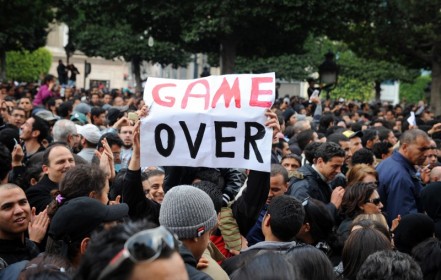
Not true as it turns out. The democratic revolution has reached Syria, and a protest movement is beginning to gain traction there. The doubters have been proved wrong.

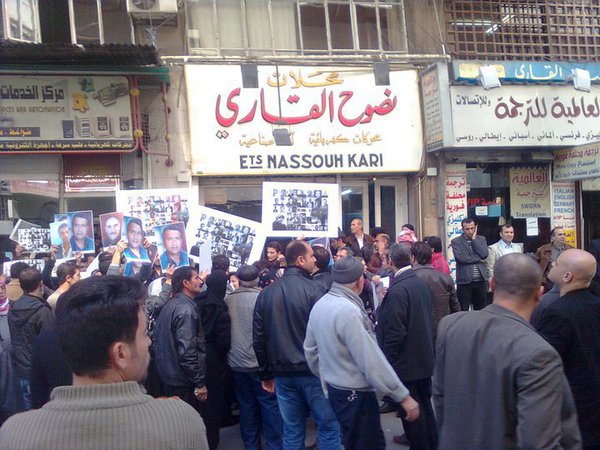
Not to get carried away, the demonstrations that have taken place in Syria have not been large-scale. We are talking about hundreds, not thousands. They did occur right across the country though, with protests taking place in Damascus, Aleppo, Deir az-Zour, Qamishli and Hassaka. The video above is for a demonstration that took place on Tuesday 15 March in the heart of Damascus. A second demonstration in the capital was organized by family and relatives of political prisoners the following day on Wednesday 16th March [pic below] opposite the Interior Ministry building. To put things into perspective, the last time an anti-regime protest took place in Syria was 31 years ago. These demonstrations, however modest, are an important ice-breaker and a harbinger of things to come.

Protest opposite Interior Ministry in Damascus, 16th March 2011

Those participating in the demonstrations have not been the usual suspects. True, there were the pro-democracy activists that we know and admire like Suheir Al-Attasi, but from the list of those arrested, the vast majority have no political affiliation and are unknown to human rights organizations. They appear to be middle class Damascenes in their twenties and thirties who reacted positively to the Syrian Revolution 2011 page on Facebook.

Fahd Faysal Al-Nijris is a typical protester. He is a university student and son of a former MP who posted this video on 14 march urging fellow students to participate in next day’s demonstrations. He says he wants freedom of expression, a decent quality of life, an end to emergency law, constitutional reform and an end to corruption. Not much different then from what the Egyptians and Tunisians had been calling for when they first hit the streets.

The demonstrations have not been confined to the capital. This YouTube video was posted on 16th March of a tribal chief criticizing the regime and calling on Syrians to participate in the “Day of Dignity” demonstrations planned for on Friday 18th March. The eastern city of Deir az-Zour has long been a hot-bed of opposition, and the army’s elite Fourth Division has been stationed there since 2006 to quell any unrest. Hassaka to the north witnessed demonstrations, so too did Qamishli, and in the southern province of Dar’a demonstrations took place amid heavy security presence. Described as “Syria’s parched farmlands”, reports have been emerging for some weeks from the southern Hawran region of a concerted anti-regime graffiti campaign, and of isolated police stations being abandoned in the build up to 15 March.

The battle at this stage appears to be one of public perception. The Syrian regime is very keen to show its people and the world that the protest movement has no popular support and that it is orchestrated by “enemies of Syria”. With diabolical efficiency, plain-clothed men of the mukhabarat have dispersed protests as soon as they begin, often using brute force and confiscating mobile phones so that footage does not come out. Not only are they overwhelming the protesters with sheer numbers and arresting them, they are also resorting to staging pro-Assad demonstrations to give the impression that the protests were in support of the regime. Semi-official news websites like this one have released dozens of reports suggesting that the protests were tiny and that they were inspired by Israel and the Muslim Brotherhood. The young people on the streets however are hitting back on YouTube, Facebook and Twitter, and of course, on independent Syrian satellite channels Barada TV and Orient TV.

The protest movement in Syria has still a lot way to go. Following yesterday’s protest, 54 have been arrested, seven of whom have since been released. They included 12 year old Ricardo Dawud, the son of political prisoner Raghida Al-Hassan, and Tayib Tizini, an acclaimed professor of philosophy. Reports of deaths has so far been unconfirmed. Bashar Al-Assad’s men appear to be avoiding unnecessary force, preferring to smother the uprising than to smash it. The challenge now for Syria’s youth is to maintain the momentum of their protest. It will not be easy.

Categories: Syrian uprising

Don’t rule out revolution in Syria just yet

March 11, 2011 11 comments

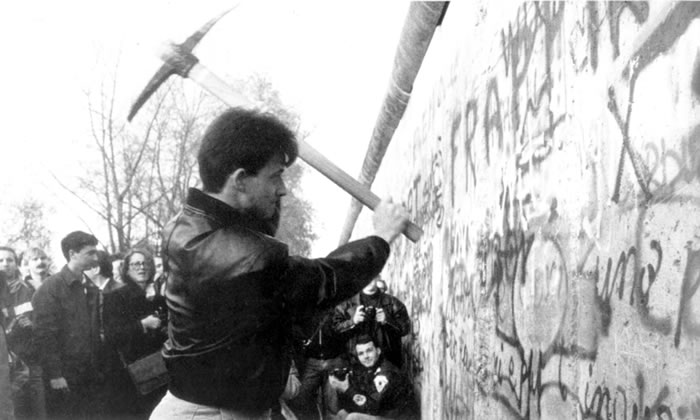
Revolutions are notoriously hard to predict. When they do happen, the experts are usually left looking silly. To illustrate the point, a university lecturer once told me of how he, the Soviet “expert”, published an article in The Times entitled “Why the Berlin Wall will not fall in my lifetime.” Weeks later in 1989, crash!

Many Middle East specialists are now finding themselves in similarly uncomfortable situations. They have quite obviously failed to predict the democratic revolutions now sweeping the region. It is not difficult to see why this has happened. Kevin Brennan writes:

Sovietologists of all political stripes were given strong incentives to ignore certain facts and focus their interest in other areas. I don’t mean to suggest that there was a giant conspiracy at work; there wasn’t. It was just that there were no careers to be had in questioning the conventional wisdom.

The problem then is succumbing to conventional wisdom. To answer the question: “Where the next revolution will take place?”, Middle East experts should now start thinking unconventionally. They should be meeting with activists and youth leaders on the ground, researching what’s happening on the blogosphere, following youth groups on Facebook and Twitter, engaging with the political opposition, monitoring local news sources, looking at what’s happening in the provinces and not only in the state capitals, and generally developing a more nuanced approach than has so far been the case. Conventional wisdom, with its emphasis on Western security concerns and macroeconomics, has been turned on its head post-Tunisia. It is at the street level that the rumblings of the next revolution will first be detected.

You would think someone will take note. This week, and within a space of only 24 hours, two articles appeared on the prospects of revolution in Syria, both of which belong firmly in the conventional wisdom school of Middle East analysis. The first was this by Rania Abouzeid in Time Magazine in which she claimed that, “much-publicized acts by Assad that have apparently helped endear him to the public include his driving to the Umayyad Mosque in February to take part in prayers to mark the Prophet Muhammad’s birthday and his strolling through the crowded Souq Al-Hamidiyah marketplace with a low-security profile.” Presumably like the impromptu appearances of Gaddafi in Green Square to thousands of jubilant supporters. 

Post-Tunisia, the Arab world is a very different place

The second article was Michael Bröning’s piece for Foreign Affairs, describing Syria as a “sturdy house that Assad built.” This was a more substantial piece, but it contains the same clichés and conjecture that plagues much of what is written about Syria these days. Bröning essentially argues that, “Despite various parallels with Tunisia and Egypt, a close look at Syria reveals that the Assad regime is unlikely to fall.” So it’s a Syria-is-not-Egypt argument. Sound familiar?

It was J K Galbraith who said, “The enemy of the conventional wisdom is not ideas but the march of events.” The problem with these analyses is that they demonstrate an unwillingness to challenge the underlying assumptions of the great debate on Syria in the light of what has happened in the region during the past three months. Tunisia proved that “performance legitimacy” was no guarantee against revolution; Egypt the extraordinary power of citizen protest; and who could trust a word of state television after Libya? Syria is as much immune from revolutionary change as Romania was in the summer of 1989.

To be fair to the Middle East experts, the Arabs themselves didn’t see what was around the corner. Now that we are on the corner however, it seems rather foolish to predict where a revolution will not take place when the same experts failed to predict the revolutions that did take place. Like the Soviet experts before them, the Middle East experts are good at many things; prophesying is not one of them.

Is Syria secretly supporting Gaddafi?

March 7, 2011 8 comments

There have been rumours circulating for some time of clandestine support being extended to Gaddafi by Syria. It started with talk of Syrian mercenaries participating in the violent crackdown on protesters in Benghazi. Then I received an email from a Barada TV viewer who said that he was one of many Syrian migrant workers stranded in Triploi who were evacuated by ship. I checked out the claim from multiple sources

Rebels celebrate after shooting down jet flown by Syrian pilot

and I discovered that a ship had indeed sailed from Tartus to Tripoli. The viewer claims that he saw many plain-clothed security men were aboard the ship, and that the ship’s crews demanded bribes to allow the stranded families safe passage back to Syria.

Circumstantial evidence perhaps. Reports then surfaced of Syrian mukhabarat arriving in Tripoli to “cleanse” the Libyan intelligence archive of evidence that may incriminate Damascus in acts of terrorism committed in the 1970s and 1980s. This particular allegation was made in Al-Hakika website, run by Paris-based Syrian journalist Nizar Nayuf. His source is an unnamed former MI6 intelligence officer who said that:

Last Wednesday [2nd March] UK authorities had observed Syrian mukhabarat officers arriving at Abdulsalam Jallud’s villa in the Libyan capital … It is believed that the “delegation” belonged to the external branch of the Syrian General Intelligence – or more likely – to the Air Force Intelligence.

Abdulsalam Jallud was considered to be the number two man in Libya until he fell out with Gaddafi in 1993. It is believed that he was involved in many acts of terrorism including Lockerbie, which were perpetrated with the active knowledge and support of the Syrians via the Abu Nidal Group and the PFLP-GC. Nayuf says that it is documents relating to these acts which are in the Libyan intelligence archives that the Syrian officers wish to destroy.

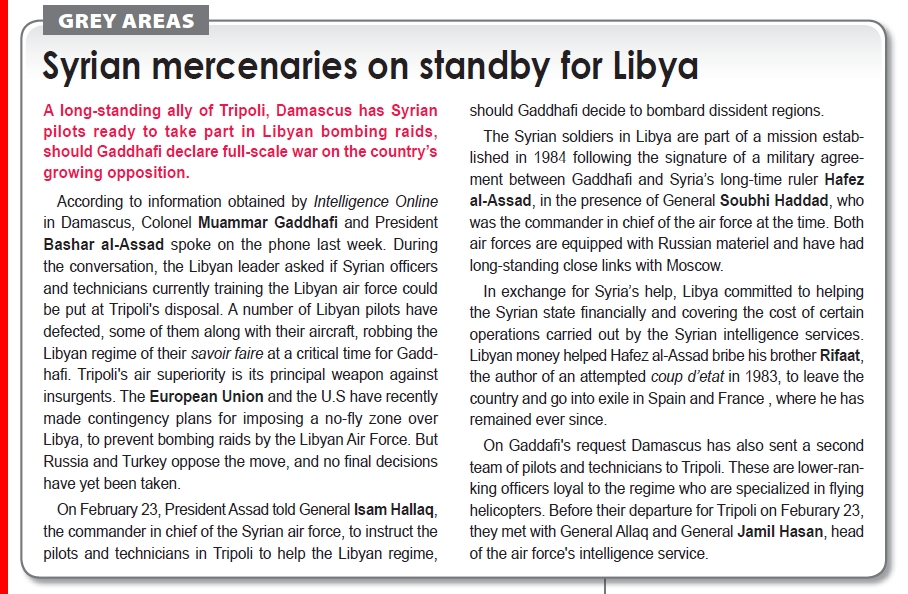
The story could be true, but I am deeply sceptical of Nayuf’s unnamed former MI6 source. A more credible report appeared in the 3 March edition of Intelligence Online (below), which says that Syrian pilots based in Libya have taken part in bombing raids against the protesters with the consent of Bashar Al-Assad himself.


The report claims that following telephone calls between the Libyan and Syrian leaders

President Assad told General Isaam Hallaq, the commander in chief of the Syrian air force, to instruct the pilots and technicians in Tripoli to help the Libyan regime should Gaddafi decide to bombard dissident regions.

A long-standing defence agreement between the two countries has meant that a number of Syrian pilots are stationed in Libya to train with the Libyan air force.

Intriguing.. and quite possibly true. What gives this story a large degree of credability was the shooting down yesterday of a Libyan air force jet by rebels, killing both pilots. After checking their ID papers, the rebels discovered that one of the dead pilots was a Syrian.

A cameraman working for France 2 captured the moment. Watch the video here.

It is of course saddening to hear of Syrians participating in attempts to crush the Libyan revolution. Unfortunately, it is does not surprise me in the least. Not only is the Libyan dictator one of Syria’s closest Arab allies, his downfall may encourage Syrians to rise up against their own regime. Reason enough then to make sure he survives.

In the post-ideological age, Arab regimes go for image makeover

March 5, 2011 3 comments

Running an Arab dictatorship is not as easy as it used to be. There was a time when all you needed was to parrot something about Islamist extremism/oil contracts/immigration/peace with Israel, and Western leaders were happy to do business with you. The growing influence of the media however, has meant that dictators have to try that little bit harder.

The Guardian has uncovered the role played by global lobbying firm The Monitor Group in improving the image of the Gaddafi regime in the US. The campaign, believed to be worth $3m, focused on paying for top academic figures from leading American universities to travel to Tripoli for personal conversations with the Libyan dictator.

The revelation reflects a growing desire by Arab regimes to improve the way that they are perceived in the West. This didn’t matter very much in the past when realpolitik considerations reigned supreme. However, the end of Soviet patronage, the decline of Arab nationalist ideology in favour of democracy and human rights, and the need to attract foreign investment to keep the armies of young people in employment, has meant that regimes in the region have had to embrace the PR industry.

Happy families: The Assads are obsessed with image

Improving a regime’s image abroad is as much about maintaining control at home. A state visit to a European capital, a well-placed article in a respected newspaper, or a well-timed photo-op creates the impression that the cherished leader is “backed by the West.” This disheartens the opposition, which assumes that the dictator and the West are in cahoots. The focus, as always, is on renewing sources of legitimacy, thereby consolidating the regime’s power over it’s people.

Cue Asma Al-Assad, the First Lady of Syria. She has appeared in Vogue this month to, and I quote the magazine, “put a modern face on her husband’s regime.” So we’ve established that it’s a marketing exercise. But it goes well beyond that. The messages that were being conveyed through the piece have been carefully constructed and tweaked to appeal to a Western audience. They seek to suggest that:

1- Assad’s Syria is a haven of security and stability in an unstable region.

2- Assad’s Syria is a “stands for a tolerant secularism in a powder-keg region, with extremists and radicals pushing in from all sides.”

3- Assad’s Syria is a reforming and modernizing Arab state, with civil society being encouraged by the first lady herself.

Using these three basic messages, regime publicists have been at it for years, using any opportunity to get positive headlines.

The dictator’s wife may well be an attractive and intelligent woman, but all that is beside the point. It’s not really about her as a person, it’s about Asma the product. The PR men have turned her into a poster child for a Syria that does not exist, and whose sole purpose is to charm the Western media for the benefit of her husband’s regime.

The Vogue piece therefore is not a one-off. It’s part of a well-organized and well-financed image makeover executed by lobbyists and image consultants, and not much different to what The Monitor Group has been doing for the Gaddafis.

Categories: Syria in the media

Seif and Bashar: a chip off the old block

March 2, 2011 7 comments

A  few days ago, the above video surfaced on YouTube of  Seif al-Islam Al-Gaddafi atop an armoured vehicle in what appears to be a morale-boosting visit to the front line.

What is interesting is that Seif is carrying a German-made H&K G36 assault rifle, not the standard issue AK-47 used by the ordinary troops. His jacket is most probably designer and so too are his glasses. This is the story of the LSE graduate, who counted Peter Mandelson as one of his close friends, now finding himself having to crush a popular uprising on behalf of dictator dad.

You might think he’s grossly out of place. Very briefly, you might even be tempted to feel sorry for him. For Arab dictator dynasties however, this is just another day in the office.

This leads me onto Bashar. I was never sold by the portrayal of him as a gentle, caring, softly-spoken reformer and modernizer. I felt there was something phony about him because had he been the gentle, caring, softly-spoken reformer and modernizer, he wouldn’t have lasted as long as he did.

It’s funny how Bashar has much more in common with Seif than he would otherwise like to admit. Both are sons of “revolutionary” dictators, both are stupendously rich, both studied in the UK, both have had military training,  both had been assigned portfolios that would endow them with popularity (anti-corruption drive for Bashar, charitable organization for Seif), and both were groomed from an early stage to assume power at a future date.

But more importantly, both have demonstrated that underneath the thin veneer of civility and Western education is a vicious and vindictive character, every bit as nasty as daddy’s.

It took the Libyan uprising for Seif’s true colours to show. Bashar on the other hand has been showing his true colours to the Syrian people for the last eleven years. His latest victim is Tal Al-Mallohi, the 19-year old blogger arrested and  recently convicted in a secret trial on trumped-up charges of spying for the CIA. I shudder to think what she has gone through in those cold and damp underground dungeons.

Then there was the Seidnaya Prison massacre of 2008 and the Qamishli massacre of Kurdish protesters of 2004. And let’s not forget the murder of Sheikh Ma’shuq Al-Khaznawi in 2005. That’s not to mention the many killings carried out in Lebanon which implicate Bashar Al-Assad personally.

I suppose the only obvious difference between the two is that Bashar made it to the top and Seif is unlikely to do so. Bloody good luck for the Libyans. Not so good for the Syrians.

Shehadi: Saddam’s downfall paved way for democratic revolution

February 27, 2011 3 comments

Arab peoples are understandably proud of the democratic uprisings that are sweeping away their tormentors at a rate of one a month. They will tell you that this is the real, home-grown democratic change that they have been crying out for, unlike the “fake” democracy in Iraq which has been imposed by foreigners and buttressed by US marines.

The beginning of the end

Amidst this euphoria and revolutionary zeal however, Arabs risk losing a historical perspective on how these uprisings came to be.

Nadim Shehadi, associate fellow at Chatham House, was in Barada TV’s studios last week and he said something very interesting. “It all started with the fall of Saddam” he said, “it just took eight years for the effects to be witnessed.” With my historian’s cap on, I couldn’t agree more.

Saddam’s Iraq was a prime example of a type of regime which came to dominate many Arab countries during the latter half of the 20th century.

This type of regime tends to be:

a) A revolutionary republic, usually erected on the ruins of a liberal monarchy and/or colonialism; b) Deeply authoritarian with a single ruling party and a frightening security apparatus; c) Personality cult, the dictator being the idealized “hero” whose images are displayed everywhere; d) Socialist, with most services provided by the state; e) Corrupt, state patronage being the major avenue; f) Anti-Western, at least in rhetoric; g) Militaristic, with huge armies and vast defence expenditure.

The key to survival for this type of regime was a combination of brute force, and wrapping itself with the national flag. Ordinary people living under such a regime appreciated its evils, but they saw no real alternative.  Looking around them, they saw other Arab peoples lived under identical regimes. “It is our fate, what can we do?” was the mood music.

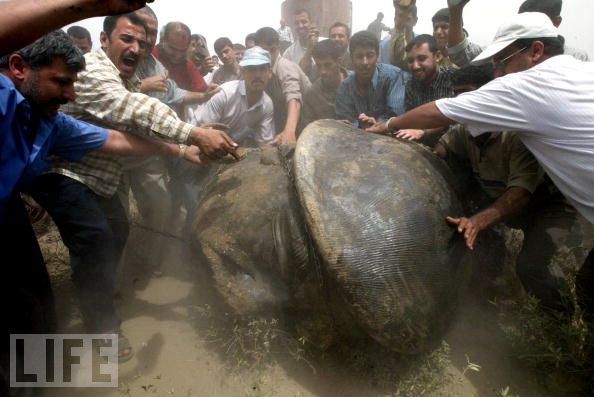
Then in April 2003 one regime of this type came crashing down. The collapse of Saddam’s Iraq was so spectacular, so swift and so ungracious, that it made Arab peoples not only question all the old certainties, but to dare imagine that a similar fate may befall their own regimes.

9 April 2003 was the day that the Arab imagination was re-awoken.

It took eight years for that burst of imagination to translate itself into action, partly because the Iraqi experience was an unhappy one. Many became cynical of Western interventionism, but it was that interventionism which began got the snowball rolling, the results of which can be seen today on the streets of Cairo, Tunis and Tripoli.

As Nadim Shehadi told me as I walked him to the lifts, “All the Arab regimes fell with the downfall of Saddam, they just didn’t know it.”

Categories: Arabs & Democracy

Guardian says tensions mounting in Syrian capital as “nervous regime” breaks up protests

February 24, 2011 Leave a comment


Further to the developing story that I discussed in the previous post, Lauren Williams reported this in the Guardian today:

Tensions are mounting in the Syrian capital, Damascus, after the third peaceful demonstration in three weeks was violently dispersed on Wednesday. There are increasing reports of intimidation and blocking of communications by secret services in the wake of violent unrest in neighbouring Arab countries.

Fourteen people were arrested and several people beaten by uniformed and plainclothes police on Tuesday after about 200 staged a peaceful sit-in outside the Libyan embassy to show support for Libya’s protesters.

Witnesses said at least two women were among those beaten.

The demonstrators carried placards reading “Freedom for the people” and “Down with Gaddafi”, and chanted slogans such as “Traitors are those that beat their people.”

Witnesses said authorities warned the group to disperse but they reconvened shortly afterwards in the central neighbouring suburb of Sha’alan. When they tried to march back to the embassy they were met with a heavy police presence.

Several witnesses told the Guardian there were nearly twice as many secret and uniformed police as protesters. Some protesters were punched, kicked and beaten with sticks..

All present had their identities recorded. Fourteen people were detained but later released, Human Rights Watch in Beirut confirmed.

“They hit two girls, I saw them on the ground crying,” said a witness who was briefly detained.

“There were so many of them, we didn’t know where they all came from.”

Under emergency law, public congregations are banned in Syria. This kind of protest is very rare but last Friday 1,500 people took part in a seemingly spontaneous demonstration outside the central Hamidiyah souq. It was reportedly in protest at the police beating of a local shop owner, rather than being directed at the government. People chanted “The Syrian people will not be humiliated”, “Shame, shame” and “With our soul, with our blood, we sacrifice for you Bashar” in reference to the country’s president, Bashar al-Assad. Syria’s interior minister has promised an investigation.

On 2 February Human Rights Watch reported a group of 20 people in civilian clothing had beaten and dispersed 15 people who had been holding a candlelight vigil in Bab Touma, Old Damascus, for Egyptian demonstrators. Police detained then later released Ghassan al-Najjar, an elderly leader of a small group called Islamic Democratic Current, after he issued public calls for Syrians in Aleppo to demonstrate for more freedom in their country.

The increase in demonstrations has been matched with an apparent crackdown on communications and movement in the country, despite public pledges of media reform from Assad earlier this month and a much-publicised lifting of the ban on Facebook and other social networking services.

Internet users who previously used international proxy servers to bypass local firewall restrictions now claim they no longer use Facebook anyway, fearing it is being closely monitored.

Civil rights campaigners have told the Guardian that initimidation tactics have escalated to include visits from agents of the Mukhabarat – intelligence services – as well as close monitoring of internet and telephone conversations. Some activists have been warned not to leave the country.

There are unconfirmed reports of a crackdown on foreign journalists working in Syria. At least two reporters have been denied entry to the country.

“The situation is tense, they are clearly nervous,” said one analyst, who refused to be named.

“We didn’t think it was possible here but maybe it could happen after all.”

For full article click here  


Categories: Syrian uprising
Design a site like this with WordPress.com
Get started